

Where Do You Start When Researching Croatian Ancestry?
Start at home.
Before searching Croatian archives or online genealogy databases, find out what information already exists within your family.
Talk to parents, grandparents, aunts, uncles and older relatives.
Ask open questions:
Where did our family come from?
What were your grandparents called?
Did anyone speak Croatian?
Do you remember the name of a village or island?
When did the family leave Europe?
Are there any old documents or photographs?
Family memories won’t always be completely accurate. Names change, dates become confused and stories evolve as they’re passed between generations.
But they provide clues.
It is often best to start research into your Croatian genealogy by gathering information from relatives and existing family documents, particularly names, surnames, dates and places of birth, marriage and death.
1. Search Your Own Family Archive
You may already have more evidence than you realize.
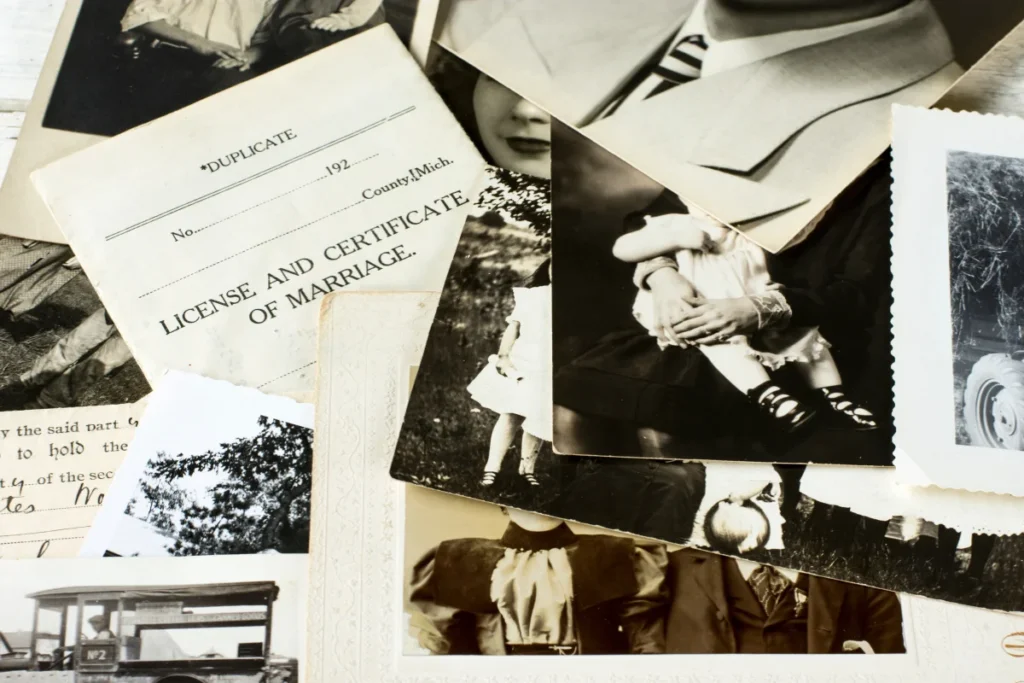
Look through boxes of old family papers, photograph albums and documents.
Particularly useful items include:
- Birth certificates
- Marriage certificates
- Death certificates
- Old passports
- Naturalization papers
- Immigration documents
- Military records
- Letters and postcards
- Family Bibles or prayer books
- Photographs with writing on the reverse
- Funeral notices
- Passenger tickets
Don’t dismiss something because it appears insignificant.
An address on a postcard might identify a village.
A marriage certificate might reveal a mother’s maiden name.
An old immigration document might record an exact Croatian birthplace that disappeared from the family’s collective memory decades ago.
These small discoveries are often how a family history begins to take shape.
2. Talk to Your Oldest Relatives
Documents tell you facts.
People tell you stories.
If older relatives are still available to speak to, consider recording conversations with them – with their permission – rather than simply taking notes.
Ask about people as well as dates.
What did their parents do?
What food did the family cook?
Did they celebrate Croatian traditions?
Did relatives belong to a Croatian club or church after emigrating?
Did anyone return to Croatia?
Were letters exchanged with relatives back home?
Ask about nicknames too.
A person remembered by one name within the family may appear under a completely different formal name in official records.
Most importantly, don’t wait for the perfect moment to collect these stories.
Some family history exists nowhere else.

3. Work Backwards, One Generation at a Time
One of the easiest genealogy mistakes is jumping immediately to the oldest Croatian ancestor you’ve heard about.
Instead, start with yourself and work backwards.
For example:
You
↓
Your mother
↓
Your grandfather
↓
Your great-grandmother
↓
Your Croatian great-great-grandfather
Try to find documentation supporting each relationship.
This prevents you from accidentally researching another person with the same name and creates a much more reliable family tree.
It’s also particularly useful if your Croatian genealogy research eventually becomes relevant to a Croatian citizenship by descent application, where demonstrating the relationship between generations can be important.
4. Find the Most Important Clue: The Croatian Hometown
If there is one piece of information worth finding, it is often your ancestor’s place of origin.
Knowing that someone was born in “Croatia” may not be enough to easily locate their records.
Knowing they came from a particular village near Split, an island in Dalmatia or a town in Slavonia dramatically narrows the search.
Look for place names on:
- Immigration records
- Passenger manifests
- Naturalization documents
- Marriage certificates
- Death certificates
- Military records
- Old passports
- Letters and postcards
And remember: the place written on the document may not say Croatia.
5. Don’t Be Confused by Yugoslavia, Austria-Hungary or Dalmatia
This is one of the most common sources of confusion in Croatian genealogy.
Croatia’s borders and political status changed substantially during the 19th and 20th centuries.
An ancestor born in exactly the same Croatian village might have records describing their birthplace differently depending on when the document was created.
You might encounter terms including:
- Croatia
- Dalmatia
- Istria
- Slavonia
- Austria
- Austria-Hungary
- Kingdom of Yugoslavia
- Yugoslavia
Some historical records may also be written in Croatian, Latin, Italian, German, Hungarian or other languages depending on the region and period.
The Croatian State Archives specifically recommends researching the administrative and parish history of an ancestor’s place of origin when determining where historical records may be held.
Source: Croatian State Archives – Genealogy
So, if your great-grandfather’s American paperwork says he was born in “Austria” in 1890, don’t immediately assume the family story about Croatia was wrong.
The historical context may explain the apparent contradiction.
6. Expect Croatian Names to Change
Names are another frequent genealogy puzzle.
An ancestor called Ivan in Croatia might later appear as John.
Josip might become Joseph.
Katarina might appear as Catherine.
Surnames can also change spelling after migration as immigration officials, employers or families themselves adapt them to another language.
Croatian letters such as č, ć, š, ž and đ may disappear or be replaced.
Women can appear under maiden names in some records and married names in others.
Don’t search for only one exact spelling.
Create a list of every version you find and compare other details – birth dates, spouses, parents, siblings and places – to establish whether the records refer to the same person.
7. Search Croatian Birth, Marriage and Death Records
Once you’ve established a likely Croatian location and approximate date, you can begin looking for records in Croatia.
Birth, marriage and death registers are among the most important sources for Croatian genealogy research.
The Croatian State Archives holds extensive collections of registers and other historical records, with its genealogical material extending across centuries.
Depending on the location and period, records may be held by:
- Croatian state or regional archives
- Civil registry offices
- Catholic parishes
- Other religious communities
- Local institutions
This is why identifying the correct location is so important.
There isn’t one single online database containing every Croatian ancestor.
Source: Croatian State Archives – Search the Records
8. Don’t Overlook Church Records
Before modern civil registration became standard, religious institutions recorded many of life’s most important events.
Parish registers may contain:
- Baptisms
- Birth dates
- Parents’ names
- Marriages
- Witnesses
- Deaths
- Burials
- Places of residence
These records can sometimes take a family tree back several additional generations.
Digitized Croatian church records are often available through online genealogy services and can include materials from Roman Catholic, Serbian Orthodox, Greek Catholic and Jewish communities, alongside other historical records.
Not every Croatian record has been digitized, however, so online research should be viewed as one tool rather than the entire solution.
9. Follow Your Ancestor’s Journey Overseas
Once you’ve found your ancestor in Croatia, follow them in the other direction.
Where did they go?
Croatians emigrated in significant numbers to countries including the United States, Australia, Canada, Argentina, Chile, Brazil, New Zealand and South Africa.
The Croatian Government’s Central State Office for Croats Abroad estimates that millions of Croatian emigrants and their descendants now live outside Croatia.
Source: Central State Office for Croats Abroad – Croatian Emigrants and Their Descendants
Records in the destination country can sometimes reveal information that Croatian records don’t.
Look for:
- Passenger lists
- Immigration records
- Naturalization applications
- Census records
- Military registrations
- Marriage records
- Death certificates
- Newspaper notices
- Croatian community organizations
Naturalization paperwork can be particularly valuable because it may record an immigrant’s original name, birthplace and arrival details.
Sometimes the easiest way to find someone’s Croatian hometown is through a document created thousands of kilometers away.
10. Build a Timeline, Not Just a Family Tree
A family tree tells you who.
A timeline helps explain what happened.
For each ancestor, record important events chronologically:
1887 – Born in Croatia
1910 – Emigrates to the United States
1912 – Marries
1914 – First child born
1920 – Appears in US census
1926 – Becomes naturalized citizen
A timeline makes contradictions easier to identify.
It can also reveal missing pieces.
If an ancestor disappears from Croatian records in 1908 but first appears in Australian records in 1910, for example, you now have a much narrower window in which to investigate their emigration.
What If You Hit a Dead End?
You probably will.
Almost every family historian eventually encounters one.
Perhaps a birth record can’t be found.
Perhaps two people share the same name.
Perhaps the village your grandmother remembers doesn’t appear on a modern map.
Perhaps the surname suddenly changes spelling.
A dead end doesn’t necessarily mean the record doesn’t exist.
It might be:
- Filed under another spelling
- Recorded in another language
- Held in a parish rather than a civil archive
- Located in a regional archive
- Indexed under a historical place name
- Not digitized
Connected to a neighboring village or parish
This is where understanding Croatian geography, historical administration and archival systems becomes particularly useful.
Professional genealogical research can help when a search reaches this stage – not by magically producing records, but by knowing where else to look and which clues to follow next.
What Can Croatian Genealogy Reveal?
The answer can be much bigger than a family tree.
You might discover the house where your great-grandmother grew up.
The church where your great-great-grandparents married.
The island your family left 120 years ago.
Relatives still living in Croatia.
Or the reason a particular tradition, recipe or name has survived within your family for generations.
For descendants who grew up thousands of kilometers from Croatia, these discoveries can transform an abstract idea of “Croatian heritage” into something tangible.
A place.
A person.
A photograph.
A record.
A story.
And occasionally, genealogical research uncovers another possibility entirely: eligibility for Croatian citizenship by descent.
Could Your Family History Lead to Croatian Citizenship?
Potentially.
Under current Croatian citizenship legislation, descendants of qualifying Croatian emigrants may be eligible to apply for citizenship, and the previous three-generation restriction for this pathway was removed in 2020.
However, discovering Croatian ancestry doesn’t automatically establish citizenship eligibility.
The circumstances of the original ancestor, their emigration and your documented relationship to them all matter.
If citizenship is one of the reasons you’re researching your family, our guides Who Is Eligible for Croatian Citizenship by Descent?, How Far Back Can You Claim Croatian Citizenship by Descent? and How to Prove Your Croatian Ancestry explain these questions in more detail.
Every Family Has a Starting Point
You don’t need a complete family tree to begin exploring your Croatian heritage.
You might have an old passport.
A photograph.
A surname.
A story about an island your grandfather once mentioned.
Or perhaps just the knowledge that somewhere, several generations ago, your family’s journey began in Croatia.
Start there.
Follow one clue to the next.
Because Croatian genealogy isn’t simply about discovering names on a family tree.
It’s about understanding the people behind those names – the places they left, the lives they built and the stories that eventually became yours.
At Salona Consulting, we help people trace those stories back to Croatia, combining genealogical research with a deep understanding of the citizenship journey that can sometimes follow.
Your Croatian story may have begun generations ago.
Discovering it can begin today
Frequently Asked Questions
How do I find out if I have Croatian ancestry?
Start with relatives and documents already within your family. Establish names, birth dates, marriages, places of origin and emigration details, then work backwards through each generation. Croatian civil and church records can help once you’ve identified an ancestor’s likely hometown or parish.
Can I search Croatian genealogy records online?
Some Croatian records are available digitally, including collections accessible through genealogy platforms such as FamilySearch. The Croatian State Archives also provides information about genealogical and archival collections. However, not every record is digitized, and some research still requires contacting archives, registry offices or religious institutions.
How do I find what Croatian village my ancestor came from?
Overseas immigration, naturalization, marriage and death records are often good places to look. Old passports, letters and photographs can also contain useful place names. Once you identify a likely location, historical maps and Croatian archival resources can help confirm it.
Why does my ancestor’s birthplace say Yugoslavia instead of Croatia?
Because the political geography of the region changed substantially during the 20th century. Someone born in a location that is now part of Croatia may have been recorded as born in Yugoslavia – or another historical state – depending on when a later document was created.
Can I trace Croatian ancestors if their surname changed?
Yes. Search for spelling variations and translated versions of first names, and compare other identifying information such as birth dates, parents, spouses and places. Name changes after emigration are common.
How far back do Croatian genealogy records go?
It depends on the region and type of record. The Croatian State Archives reports that its collections include birth, marriage and death registers dating from the 17th to the 20th centuries, while some digitized church collections also extend back several centuries.
Source: Croatian State Archives – Our Records

Viktorija Obadić
Marketing Assistant | Salona Consulting